


1.Why Project Planning is Critical in EPC Projects
Engineering, Procurement, and Construction (EPC) projects are among the most complex project environments. They involve multiple stakeholders, tight schedules, and high financial exposure.
Without a robust planning process, projects quickly face:
- Delays
- Cost overruns
- Coordination issues
👉 Project planning is not just about creating a schedule — it is about building a structured roadmap that ensures execution readiness.

The EPC Planning Framework
Effective planning in EPC projects follows a structured and logical approach.
1. Define Project Scope
- Clearly identify deliverables
- Set objectives
- Define project boundaries
👉 A poorly defined scope leads to constant changes and schedule instability.
2. Develop the Work Breakdown Structure (WBS)
Break the project into manageable components:
- Engineering
- Procurement
- Construction
👉 A strong WBS is the foundation of a reliable schedule.
3. Define Activities and Logic
Each activity must be:
- Clearly defined
- Measurable
- Linked to other tasks
Dependencies (Finish-to-Start, Start-to-Start, etc.) define workflow.
👉 This is what transforms a project into a structured system.
Building the Project Schedule
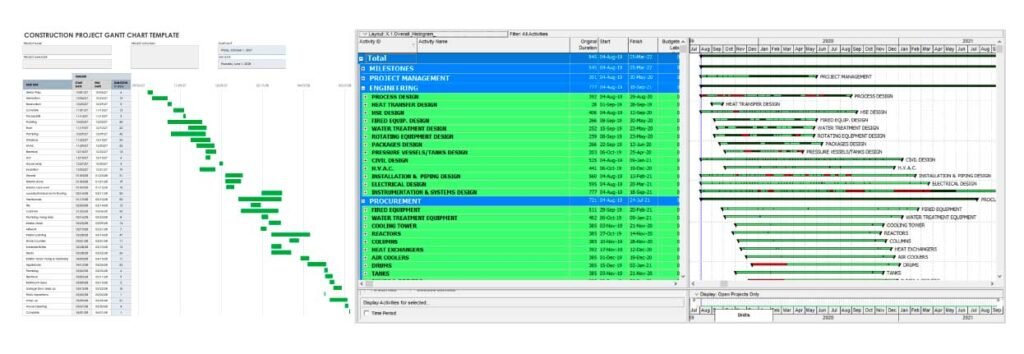
Once activities are defined, the schedule is developed using tools such as:
- Primavera P6
- Excel
Key elements include:
- Activity durations
- Resource allocation
- Milestones
- Constraints
👉 The output is typically a Gantt chart, providing a clear visual timeline.
Understanding the Critical Path
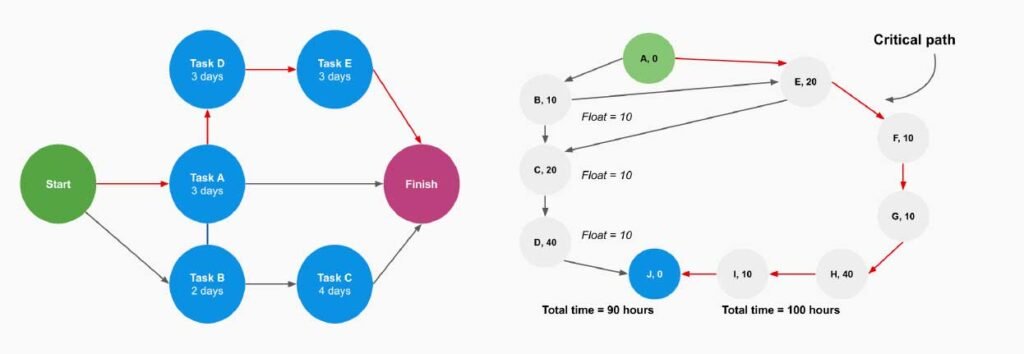
The critical path is the sequence of activities that determines the shortest project duration.
- Activities have zero float
- Any delay directly impacts completion
👉 Monitoring the critical path is essential for project control.
Common Planning Challenges in EPC Projects
Even with the right tools, planning can fail due to:
- Incomplete scope definition
- Poor interface management between teams
- Unrealistic durations
- Lack of progress tracking
- Weak communication
👉 Success requires not just tools, but discipline and coordination.
Planned vs Actual Progress (S-Curve)
A powerful monitoring tool is the S-curve:
- Planned curve = expected progress
- Actual curve = real progress
- Gap = delays or acceleration
👉 This helps teams quickly identify performance issues.
Tools Used in EPC Planning
Professional planning relies on:
- Scheduling software (Primavera P6)
- Spreadsheets
- Progress dashboards
- Reporting tools
👉 Tools support planning — but methodology drives success.
From Planning to Execution Readiness
A good plan is not just documentation — it is a decision-making tool.
It enables:
- Better coordination
- Early risk identification
- Accurate forecasting
- Clear stakeholder communication
👉 Planning turns complexity into control.
Learn Project Planning with Surus
At Surus, our training programs focus on real-world application:
- Build schedules from scratch
- Master logic and critical path
- Monitor and forecast performance
- Apply planning in EPC environments
👉 Our Planning & Scheduling Professional program is designed to make you operational immediately.